
J D Vance heads to Islamabad for high-stakes US-Iran talks, balancing cautious optimism with a warning against bad faith. negotiations.
Production growth in India's eight core infrastructure sectors slowed to a three-month low of 2.3 per cent in February, impacted by contractions in crude oil, natural gas, and refinery products output.

18 Indian-flagged vessels with 485 Indian seafarers still remain in the western Persian Gulf region

The National Payments Corporation of India (NPCI) is set to consider linking the ATM interchange fee to the Wholesale Price Index (WPI), alongside a potential hike from the current 19 to 21-22, which could impact customer charges for transactions beyond the free limit.

New Zealand captain Mitchell Santner says the T20 World Cup final against India is 'not just another game' as the Black Caps aim to seize key moments and lift the title.

Indian girls and boys teams secured dominant victories against Sri Lanka and Maldives respectively at the ITTF-ATTU Asian Youth Table Tennis Championships.
Argentina has significantly increased its LPG exports to India to help mitigate shortages caused by the ongoing conflict in West Asia. This partnership is becoming increasingly important for India's energy security.

Despite significant price differences, Indian farmers are increasingly adopting non-subsidised speciality fertilisers, which are seen as a potential solution to the rising fertiliser subsidy burden exacerbated by global supply shocks.

US Special Representative Sergio Gor met with Sri Lankan President Anura Kumara Dissanayake to discuss strengthening bilateral relations and Sri Lanka's stance on the Middle East crisis. The visit occurs amidst regional tensions and US efforts to secure trade routes in the Indo-Pacific.

The Indian rupee rebounded against the US dollar after the Reserve Bank of India (RBI) restricted banks' net open positions in dollars. This move prompted banks to sell dollars, providing temporary support for the rupee amidst ongoing geopolitical tensions and rising oil prices.

Indian eateries are adapting to the LPG crisis by cutting menus, increasing prices, and switching to alternative fuels like coal, as LPG supplies are disrupted due to global events. State authorities are cracking down on hoarding and black marketing of LPG cylinders.

Amidst escalating tensions in West Asia, Russian President Vladimir Putin is actively calling for de-escalation and political resolution, engaging with Iranian and US counterparts to navigate the complex conflict landscape.

Amid West Asia crisis, England, South Africa and West Indies to depart over the weekend.

'It would be similar to what happened during COVID-19.' 'They are not just losing income, but being pushed into distress.'
Opposition MPs in the Rajya Sabha criticised the Modi government's economic policies, citing the LPG crisis, lack of energy security, and concerns over the Economic Stabilisation Fund.

US President Donald Trump will visit China from May 13 to 15 at the invitation of President Xi Jinping. The visit occurs amidst global tensions, including the war in West Asia and trade disputes between the US and China. Discussions are expected to cover China-US relations, world peace, and economic issues.

Defence Minister Rajnath Singh assures India's energy security amidst West Asia tensions, highlighting naval protection of tankers and readiness to counter cross-border terrorism.

Iran has blamed the US for disruptions in oil and gas shipping through the Strait of Hormuz, citing 'destabilising actions' as the cause amid the ongoing West Asia conflict and rising energy prices.

The Pakistan Cricket Board is adapting the 2026 Pakistan Super League due to a fuel shortage, with matches played without fans and at only two venues.
S&P Global Ratings projects India's economy to grow at 6.3 per cent even if crude oil prices average USD 130 per barrel in the current fiscal year, highlighting the nation's resilience amidst the West Asia crisis and strong commitment to fiscal consolidation.

India should not stay on the margins of this initiative. There should be a serious debate about what would be in India's best interests asserts former foreign secretary Shyam Saran.

Hyundai Motor India Ltd (HMIL) announced plans to make Tamil Nadu its 'flagship EV hub for India', committing over 26,000 crore in investment, enhancing localisation, and creating approximately 2,000 additional jobs over the next five to six years. The company will roll out two new EV models from its Chennai facility this year, including its first mass-market dedicated EV.

Several residents of Amethi, Uttar Pradesh, including students, are stranded in Iran due to ongoing joint strikes by the United States and Israel, prompting calls for government assistance.

Jan Suraaj Party founder Prashant Kishor has moved to an ashram on the outskirts of Patna to continue his political activities ahead of the next assembly elections. He criticised Nitish Kumar and urged voters to prioritise their own interests.
Commerce and Industry Minister Piyush Goyal announced that a US team is expected to visit India next month for trade talks, following an earlier Indian delegation's visit to Washington, DC, in April to finalise an interim pact and advance negotiations for a broader bilateral trade agreement.

Much will depend on how the protagonists use the current interlude to work proactively for the beginning of a durable settlement or, on the contrary, prepare for a new round of escalation, points out Ambassador M K Bhadrakumar.

Flex fuel motorcycles can deliver "3 per cent higher torque and 7 per cent higher peak power".

US Secretary of State Marco Rubio arrived in Kolkata for a four-day diplomatic tour to India, marking the first visit by a US secretary of state to the city in 14 years. His itinerary includes meetings with Indian officials, energy talks, and a Quad Foreign Ministers Meeting.

Prime Minister Narendra Modi spoke with leaders from Oman, Kuwait, and Qatar, expressing concern over attacks in West Asia and discussing the safety of the Indian community.

In view of the disruptive situations, the Central government has also announced a financial relief package of Rs 497 crores aimed at helping exporters affected by disruptions in West Asia.

The Indian government has issued a stern warning to industrial users who are reportedly procuring cheaper retail fuel instead of industrial-grade fuel, leading to significant losses for state-run oil marketing companies (OMCs) and potential local shortages. This diversion, driven by a substantial price difference between retail and bulk diesel, is adversely impacting OMCs, which are absorbing daily losses of approximately 550 crore to keep retail prices stable.

The Indian central government has reduced its total expenditure by approximately 60,000 crore in FY26, below its revised estimate, to successfully achieve the fiscal deficit target of 4.4 per cent of gross domestic product (GDP), according to the latest data from the Controller General of Accounts (CGA).

'After that the burdens of an ageing population will be upon us, and the share of working age population will shrink.'

Due to airspace restrictions resulting from the conflict in the Middle East, Indian domestic carriers have cancelled 278 international flights. Some airlines are operating limited services and special flights to assist stranded passengers.

India is well-stocked with inventories of crude oil and key petroleum products, including petrol, diesel, and aviation turbine fuel (ATF), to deal with short-term disruptions as the war intensifies in West Asia, Union Minister of Petroleum and Natural Gas Hardeep Singh Puri said on Tuesday.

Closely watched by the world for any escalation, the Iran-Israel conflict is already showing early signs of stress for India Inc - longer deliveries, doubling freight rates, extended working capital cycles, and higher costs. For those yet to feel the heat, there is growing apprehension and nervousness over future developments, observed industry executives.
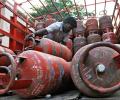
Police in Thane district seized 84 illegally stored LPG cylinders worth Rs 2.22 lakh from a private premises in Bhiwandi, leading to a case against three individuals under the Essential Commodities Act. The raid comes amid increased vigilance to prevent hoarding and black marketing of domestic gas cylinders.

'FPIs are unlikely to return unless there is equilibrium between valuation premium and earnings growth.'

The cost of the war is being counted not in the corridors of power in Washington or Tehran, but in Firozabad's darkened furnace rooms, Howrah's idle casting sheds, and a barbershop in Kochi where the wait is suddenly, inexplicably, an hour long, notes Prem Panicker in his must read blog on the Iran War.
Responding to concerns raised by Leader of the Opposition Rahul Gandhi in the Lok Sabha, Petroleum Minister Hardeep Puri said it is the foremost priority of the government that the kitchens of over 33 crore families, especially the poor and the underprivileged, do not face any shortage of gas.
